
SEO has become more competitive than ever. Whether you’re a blogger, a small business owner, or someone just starting to learn SEO, improving your website’s visibility takes time, research, and consistent effort. Tasks like keyword research, content planning, on-page optimization, and performance analysis can quickly become overwhelming, especially for beginners.
This is where Artificial Intelligence (AI) is making a real difference. Instead of replacing SEO professionals or content creators, AI helps simplify many repetitive and time-consuming tasks. From generating keyword ideas and creating content outlines to improving readability and identifying optimization opportunities, AI allows you to work more efficiently while still keeping your creativity and decision-making in control.
However, AI should be viewed as a helpful assistant rather than a complete solution. It can speed up your workflow and provide valuable insights, but successful SEO still depends on human creativity, critical thinking, and creating content that genuinely helps readers.
In this guide, we’ll explore how AI is changing modern SEO, the tasks it can help with, the best AI tools for different SEO activities, and the best practices for using AI responsibly toachieve smarter optimization.
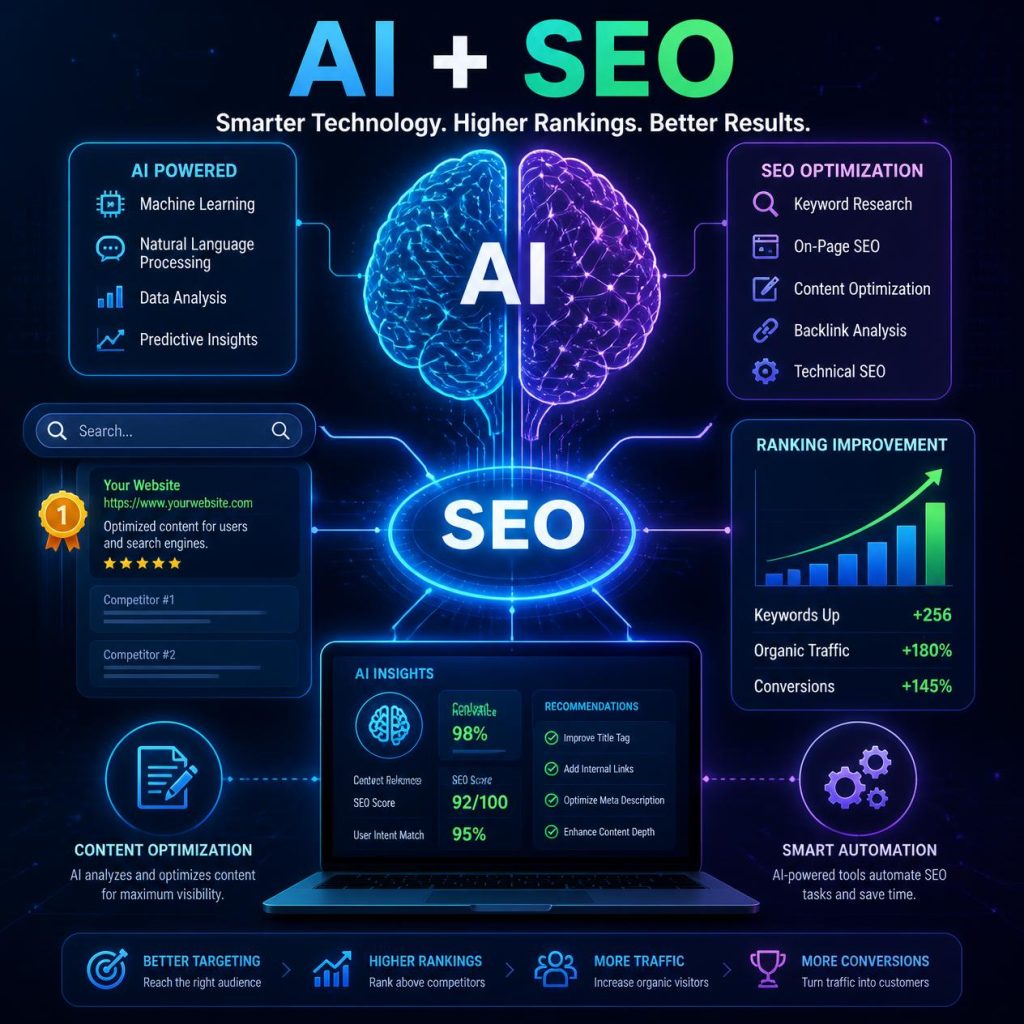
Why AI Matters in Modern SEO
AI is really important in SEOnow because search engines have become so advanced that it is just not possible to do everything manually anymore. For example, search algorithms are using sophisticated artificial intelligence to deeply understand the content and the user’s intention. Besides, manually keeping up will be too time-consuming. AI software helps you to instantly identify obscure keyword sequences, find competitor’s weak points and execute background technical issues that are really boring to the human in just a few seconds. It is like giving everyone the same chances, so that you spend time on your main task, i.e. producing high-standard, reader-friendly materials, instead of working on endless times in spreadsheets.
How AI Helps in Every Stage of SEO
-
Keyword Research:
Frame this around speed and scale. AI doesn’t just find keywords; it can analyze thousands of terms in seconds, filtering out high-competition phrases and finding low-hanging fruit you’d normally miss.
-
Search Intent:
Explain how AI goes beyond matching words to understanding why someone is searching. It can instantly tell you if a user wants to buy something, find a specific website, or just read a quick guide.
-
Content Planning:
This is all about topic clustering. Explain how AI takes a massive list of keywords and organizes them into a neat content calendar, showing you exactly which articles to write first to build authority.
-
Content Creation:
Keep it realistic here. Frame AI as a co-writer and brainstormer, not a replacement. It’s perfect for breaking writer’s block, building outlines, and generating first drafts that you can inject your personality into.
-
On-Page SEO:
Focus on optimization alignment. AI tools can look at top-ranking competitors and tell you exactly what headers (H2s/H3s) you missed or what key phrases you need to add to match what search engines want.
-
Technical SEO:
Demystify this for your readers. Frame AI as a non-coder’s best friend that can instantly generate schema markup code, write robot.txt files, or find broken links across your site.
-
Link Building:
This is usually the hardest part of SEO. Explain how AI helps by finding outreach opportunities (like scanning the web for blogs in your niche) and writing personalized, non-spammy pitch emails to editors.
-
Local SEO:
If your readers run local businesses, explain how AI automates managing Google Business Profiles, tracking local keyword rankings, and quickly replying to customer reviews.
-
Reporting & Analytics:
Frame this as finding the “so what?” in the data. Instead of staring at confusing Google Analytics charts, AI can look at your traffic report and tell you in plain English: “Your traffic dropped because Page X lost its ranking—here is how to fix it.”
Best AI tools for SEO
When picking AI tools for your blog, the trick is choosing software built for the specific job you are doing. The industry has shifted away from cheap “AI text generators” toward smart tools that analyze real search data and track how visible you are.
Here are the best tools based on what you need them to do:
-
For Content Optimization: Surfer SEO or Clearscope
These tools are the gold standard for actual writing. They scan the top-ranking articles for your keyword and give you a live score as you type, telling you exactly which subheadings, questions, and phrases you need to include so search engines see you as an authority.
-
For Research & Outlines: Frase.io
If you get stuck before you even start writing, Frase is perfect. It digs through Google results, Reddit threads, and Quora questions to instantly build detailed content briefs, showing you exactly what your audience cares about.
-
For Technical Work & Speed: ChatGPT (Plus) or Claude
You don’t need expensive software for everyday grunt work. The premium versions of ChatGPT and Claude are unmatched for taking a messy list of 500 raw keywords and instantly sorting them into neat categories, or writing backend code like schema markup for your site.
-
For Tracking AI Search Visibility: Semrush (AI Visibility Toolkit) or Spotlight
Because search is changing, these modern tools don’t just track your Google rank; they show you how often your blog posts are being cited and recommended inside AI engines like ChatGPT, Perplexity, and Google AI Overviews.
The Real Benefits of Inviting AI into Your SEO Workflow
Using AI for SEO isn’t about cutting corners or letting a machine do your thinking. It’s about taking the leverage that data gives you and using it to grow your site faster. If you incorporate AI into your blogging routine, here are the major benefits you’ll notice almost immediately:
- You Reclaim Hours of Mindless Prep Work: The biggest drain on a blogger’s time isn’t writing; it’s the hours spent sorting through spreadsheets, checking competitor headings, and trying to find search volume trends. AI compresses a weekend’s worth of data crunching into a few clicks, giving you your time back to focus on the actual creative writing.
- You Stop Guessing What Will Rank: Instead of crossing your fingers and hoping an article performs well, AI tools analyze the exact patterns of top-ranking sites. They tell you exactly what questions your audience wants answered and what subtopics you need to cover, giving you a clear, data-backed roadmap before you type a single word.
- It Level-Plays the Technical Stuff: You don’t need to be a web developer to have a perfectly optimized site anymore. AI acts as an on-demand coder, instantly writing complex schema markup, fixing broken redirect code, or auditing your site layout for speed issues that could be hurting your Google rankings.
- You Catch Traffic Drops Before They Hurt: Tracking data manually means you usually don’t notice a drop in rankings until your traffic has already tanked. AI analytics tools monitor your blog in the background, instantly flagging pages that are slipping and telling you exactly which paragraphs to refresh to win your traffic back.
- It Erases the Dreaded “Blank Page” Syndrome: Writer’s block is a massive time-killer. Having an AI assistant to bounce ideas off of, generate catchy headline options, or flesh out a rigid content outline means you can jump straight into the flow of writing with momentum already on your side.
The Big Picture: Ultimately, the greatest benefit of AI isn’t the software itself—it’s that it frees you up to do the human things that algorithms love, like sharing real personal experiences, building unique case studies, and connecting with your readers.
The Hard Limits: What AI Can’t Do for Your SEO
While AI is an incredible assistant, treating it like a magic autopilot button is the fastest way to tank your blog’s traffic. Search engines—and more importantly, real human readers—can spot lazy AI implementation from a mile away.
If you want your site to survive long-term, you need to understand exactly where AI hits a wall:
- It Lacks True Human Experience (The “E” in E-E-A-T): Google aggressively prioritizes Experience in its search rankings. AI can synthesize existing facts, but it can’t test a product, share a personal mistake, tell a funny anecdote, or offer a unique case study. Without that real-world human perspective, your content will feel flat and struggle to rank.
- It suffers from “Hallucinations” and Outdated Data: AI models are built on historical data and predictive patterns—meaning they don’t actually know if a fact is true; they just know what words usually follow each other. If you trust an AI tool to write your facts blindly, it will eventually invent fake statistics or pull outdated info, destroying your blog’s credibility.
- It Creates a “Sea of Sameness”: Because AI tools pull from the same pool of top-ranking search results to build their recommendations, they inherently tell everyone to write the exact same thing. If every blogger in your niche uses AI to write their articles, everyone ends up with identical, generic content. To rank, you have to offer something fresh that the AI didn’t suggest.
- It Can’t Replicate a True Brand Voice: AI can mimic tone to an extent, but it struggles with nuance, cultural slang, sarcasm, and deep emotional resonance. A blog that relies entirely on AI text loses its distinct personality, making it incredibly hard to turn casual Google searchers into loyal, email-subscribing fans.
- It Doesn’t Understand Real-Time Context: AI operates on what it has already learned. It struggles to understand a breaking news event, sudden cultural shifts, or a brand-new algorithm update that happened this morning. Relying solely on AI means you will always be a step behind the immediate trends happening in your industry.
Best Practices for Using AI Responsibly (and Safely)
If you want to use AI without getting penalized by search engines or losing the trust of your audience, you need a smart framework. The goal isn’t to hide the fact that you use AI, but to use it so intelligently that your content actually gets better, not lazier.
Here is how to use AI responsibly to keep your blog in Google’s good graces:
- Treat AI as the Architect, Not the Builder: The safest rule of thumb is to let AI handle the structure and layout, while you handle the actual bricks. Use it to generate outlines, brainstorm title ideas, and cluster your keywords. When it comes to writing the actual paragraphs, let your own voice and fingers do the heavy lifting.
- Be Ruthless with Fact-Checking: Never publish a statistic, quote, or historical fact generated by AI without verifying it yourself first. It takes less than a minute to open a new tab and confirm a data point, but it takes months to rebuild your blog’s reputation if you publish fake or hallucinated information.
- Inject Your Own “E-E-A-T” into Every Post: Search engines want to see Experience, Expertise, Authoritativeness, and Trustworthiness. Every time you use an AI outline, make a conscious effort to add something an AI could never know—like a personal mistake you made, a screenshot of your own results, or an anecdote from your life.
- Edit for Personality and Flow: AI writing tends to use predictable, repetitive phrases (like “In today’s digital landscape” or “delve deeper”). Read your content out loud before hitting publish. Cut out the robotic fluff, break up long sentences, and add your own unique style so it reads like a conversation between two friends.
- Focus strictly on Search Intent, Not Word Count: Don’t use AI to pad your articles with extra fluff just to make them look longer. Google doesn’t reward length; it rewards helpfulness. Use AI to ensure you are answering the user’s question as quickly and clearly as possible, rather than using it to generate hundreds of words of empty text.
When you look at how fast the digital world is moving, AI isn’t some luxury shortcut—it’s the tool that keeps you from drowning in endless keyword spreadsheets and technical data. Modern SEO has simply gotten too competitive to handle entirely by hand, and using AI to map out your outlines and sort your research is how you survive the grind. It takes the exhausting, administrative side of blogging and shrinks it down from hours to seconds, giving you your time back.
But the real trick to smart optimization is remembering that data only gets you to the starting line. AI can build a perfect structure and find the right keywords, but it can’t replicate your personality, your real-world experiences, or the unique perspective your readers come to you for. By letting AI handle the boring behind-the-scenes busywork, you give yourself the freedom to focus on the one thing a machine can’t copy: writing great content that connects with real people.